India
Around the World in Eighty DaysIndia is presented as a vast and politically uneven setting where the promise of rapid modern travel meets both an unfinished railway and the limits of British authority. Its role in the journey is not merely geographical: the country’s contested jurisdictions create the crisis that leads Phileas Fogg and his companions to rescue Aouda, while the contrast between scheduled transport and local interruption tests Fogg’s confidence in his timetable.
Scale and Political Geography
The novel’s geographical account describes India as a landmass of about 1.4 million square miles, with a population of 180 million. It distinguishes this expansive whole from British India, which it gives as roughly 700,000 square miles and 100 to 110 million inhabitants. British rule, the account says, directly covers the larger portion of the country, with the Crown governing through a governor-general at Calcutta and governors at Madras, Bombay, and Bengal, as well as a lieutenant-governor at Agra. The figures and administrative labels establish the scale on which the journey is imagined, but also insist that political control is not uniform.
The account marks that unevenness by describing some interior territories as outside British authority and certain rulers as independent. It traces the East India Company’s rise from its first foothold near Madras in 1756 through the annexation of provinces, then presents its authority as having passed to the Crown after the Sepoy insurrection. This compressed history makes the landscape a record of changing power: the country’s political boundaries and social distinctions, the narrator says, are themselves changing. Later events in Bundelcund give that general statement an immediate consequence, since British officials cannot simply enforce their judgment there.
Railways, Distance, and the Broken Route
India is also mapped as a transportation system in transition. The novel contrasts older travel on foot or horseback, by palanquin, and in cumbersome coaches with steamboats on the Indus and Ganges and a railway said to cross the peninsula from Bombay to Calcutta in three days. The railway’s advertised speed does not mean a direct route: although the straight-line distance between the two cities is given as 1,000 to 1,100 miles, the track’s deviations add more than a third to the journey.
The Great Indian Peninsula Railway’s described route makes that infrastructure legible as a sequence of connections. From Bombay it crosses from Salcette to the mainland opposite Tannah, passes over the Western Ghauts, and continues northeast toward Burhampoor. It skirts Bundelcund, climbs to Allahabad, turns east to meet the Ganges at Benares, and proceeds through Burdivan and Chandernagor to Calcutta. The itinerary suggests a connected peninsula, yet the journey reveals that the line has not in fact been completed as announced.
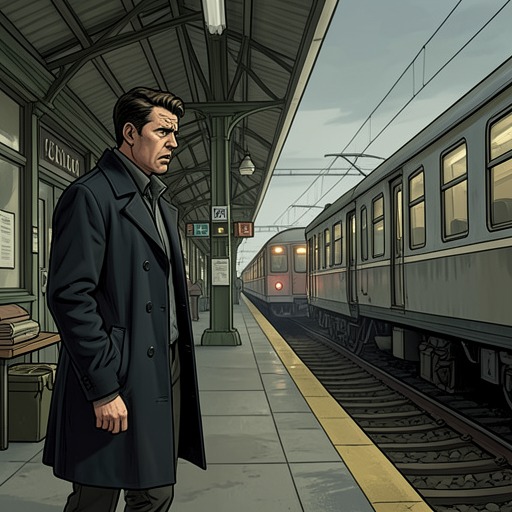
At Kholby, the train stops because the railway ends. A gap of about fifty miles remains before the line resumes at Allahabad. The interruption turns a small place on the route into a decisive test of the timetable: Fogg explains that he had anticipated some obstacle and has two days already gained to spend. He still expects to reach Calcutta in time for the steamer to Hong Kong leaving at noon on October 25. The newspapers’ premature report of the line’s completion is thus set against the physical reality of the missing track; passengers must find local transport, while Fogg treats the delay as a contingency his schedule can absorb.
Bombay and the Travelling Gaze
The passengers from the Mongolia land at Bombay at half past four in the afternoon, with the train due to leave at eight. Fogg parts from his whist partners, gives Passepartout errands, and walks to the passport office with the same measured step that the narration compares to an astronomical clock. He declines to visit the city’s hall, library, forts, docks, bazaars, mosques, synagogues, Armenian churches, or the pagoda on Malabar Hill. He also passes over the works at Elephanta and the Buddhist remains in the Kanherian grottoes.
This refusal makes Bombay less a sightseeing destination than a timed point of departure. The narration offers an inventory of urban and religious landmarks, but Fogg’s attention is fixed on the passport office, the station, and his schedule. His indifference contrasts the country’s historical and architectural abundance with the narrow priorities of a traveller measuring each stop by its usefulness to the journey. India is made visible to the reader through description, even as its principal traveller declines to look.
Bundelcund and the Limits of Authority
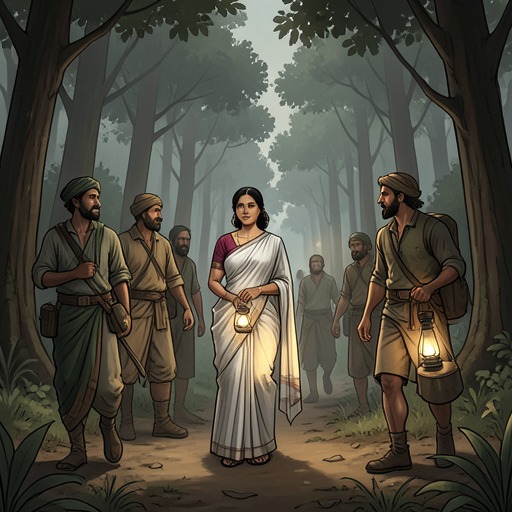
The journey through Bundelcund brings political geography into direct contact with human danger. The party encounters a procession accompanying a young woman and the body of her husband, an independent rajah. The corpse is dressed in princely finery, while armed guards, musicians, and fakirs surround the procession. Sir Francis Cromarty identifies the event as suttee; the guide confirms that the dead man is the woman’s husband. Aouda is in danger of being forced to die with him.
Fogg asks whether such customs still exist and why the English have not stopped them. Sir Francis answers that the practice does not occur across most of India, but that the British have no power over these territories, especially Bundelcund, which he describes as afflicted by murder and pillage. The exchange places an ethical objection beside a jurisdictional limit: opposition to the custom does not itself give the travellers authority to prevent it. The episode therefore complicates the earlier account of extensive Crown dominion, exposing the distance between a claim of rule over much of India and effective control in a particular district.
After Aouda is rescued, she cannot safely remain in India: her former pursuers might find her again even in major cities such as Madras, Bombay, or Calcutta. At Allahabad the railway resumes, and the party can continue toward Calcutta in time for the Hong Kong steamer. The country’s narrative importance lies in this double movement: its rail network carries the travellers onward, while its political divisions create both the interruption and the moral obligation that alter their journey.